Address
600 California St, San Francisco, CA 94108
Adople builds enterprise AI solutions and AI agents that automate critical workflows, connect fragmented data, and transform information into intelligent action.
Intelligence for the decisionsbehind finance.
Financial organizations operate across data, documents, systems, policies, transactions, and increasingly complex workflows. Adople applies AI across financial operations—from analyzing live business data and understanding company filings to managing liquidity, retrieving financial knowledge, and moving operational work forward.
02 / THE FINANCIAL ENVIRONMENT
Finance runs on information. Decisions depend on context.
A financial decision rarely comes from one system. Cash positions, business performance, research filings, internal policies, and operational work all live across separate tools and teams.
01
Cash Positions
Banking & Treasury Systems
Real-time balances, multi-currency accounts, cash movements, and bank statement feeds.
02
Business Performance
ERP & General Ledgers
P&L variances, subledger reconciliations, cost allocations, and live financial reporting.
03
Research & Filings
Filings & Disclosures
SEC 10-K/10-Q statements, footnote disclosures, earnings reports, and public disclosures.
04
Policies & Controls
Documents & Knowledge Repositories
Internal compliance standards, risk limits, accounting policies, and regulatory guidelines.
05
Operational Work
Applications, Approvals & People
Exception workflows, dual-authorization review, ledger commitments, and human sign-off.
THE OPPORTUNITY FOR FINANCIAL AI
AI shouldn’t simply generate answers. It must understand context and execute work.
Financial leverage comes from connecting the underlying data, verifying every computation against deterministic controls, and driving decisions directly into downstream systems.
01 / CONTEXT
Unified Multi-Source Context
Reconciles live banking feeds, general ledgers, subledger entries, and SEC filings into a single deterministic knowledge graph.
02 / VERIFICATION
Deterministic Evidence Validation
Every number is checked against accounting standards and enterprise risk rules, with footnote citations back to the source disclosure.
03 / EXECUTION
Audited Ledger Execution
Commits reviewed transactions directly into ERP and treasury workflows with dual-authorization gates and immutable audit trails.
03 / FINANCIAL WORK
Different financial workflows. One connected intelligence layer.
Financial teams do not have one AI problem. They work across different information, decisions, and levels of operational control. Adople applies AI across the parts of finance where understanding information, investigating change, and moving work forward matter most.
WORKFLOW DOMAIN 0.1
Financial Data & Analysis
From business questions to usable financial intelligence.
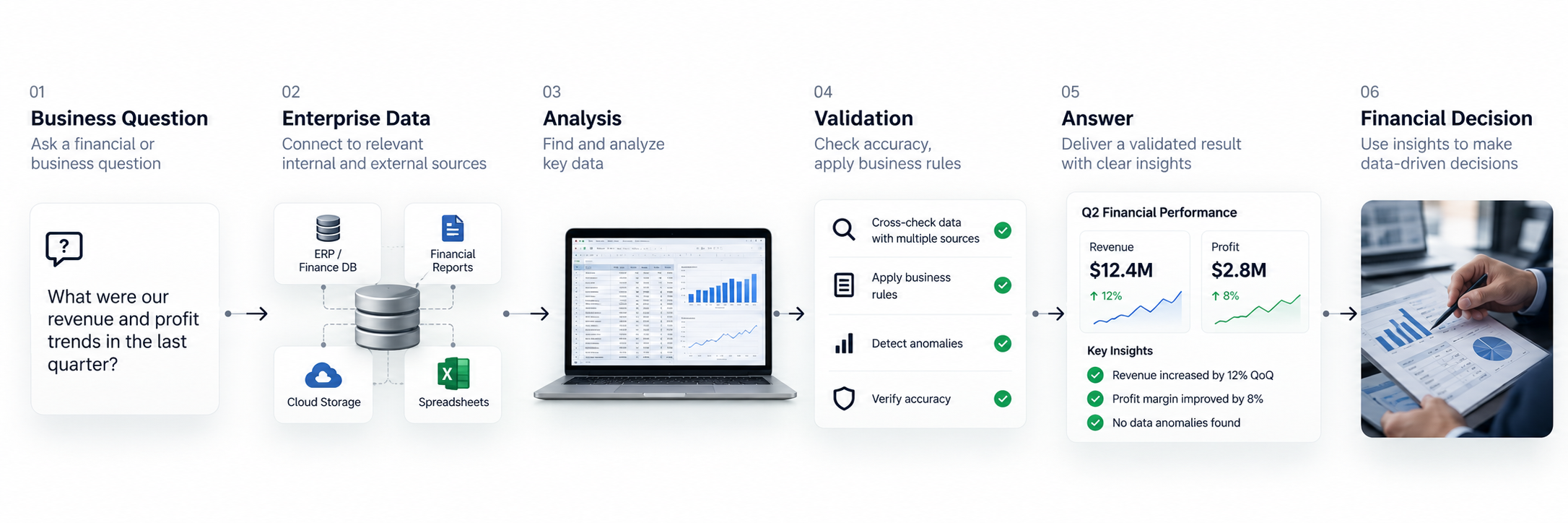
Financial teams need to move beyond static reports and manually assembled analysis. Adople connects questions with enterprise data so teams can investigate performance, understand what changed, and produce analysis grounded in the underlying business information.
04 / FROM INFORMATION TO ACTION
Bring the right information together before the decision.
A financial question can begin anywhere: a number that changed, a filing that was published, a liquidity position that needs attention, or a policy that needs to be interpreted. Adople connects the relevant information and context, analyzes what matters, and brings the result into the workflow for review and action.
01
Connect
Live data, documents, and banking systems ingested into a single contextual environment.
02
Understand
Financial context, accounting rules, policy guidelines, and user intent parsed deterministically.
03
Analyze
Variance modeling, cash flow trajectory, risk metrics, and line-item comparisons computed.
04
Review
Traceable source citations, evidence footnotes, and flagged exceptions prepared for human review.
05
Act
Approved decisions passed directly to operational ERP, cash movements, or downstream workflows.
05 / FINANCIAL DECISIONS
Different financial decisions require different context.
From managing liquidity to investigating performance, reviewing risk, and moving operational work forward, financial teams work with different information at different points in the decision process. Adople brings the relevant data, documents, policies, and business context together around the question being asked—so teams can move from information to informed action.
Treasury & Liquidity
Know where the money is—and what needs attention.Treasury decisions depend on a current view of balances, cash movements, forecasts, reconciliations, and payment activity. We bring these signals together to help treasury teams understand the financial position, investigate changes, and move the right items into review and approval.
Finance & FP&A
Move from numbers to the reasons behind them.Financial planning is not only about seeing a variance. Teams need to understand what changed, what is driving it, and where further investigation is needed. We connect financial questions with enterprise data so teams can investigate performance, compare relevant information, and build analysis around the business context behind the numbers.
Research & Investment
See the company behind the filings.Research often requires moving across multiple filings, reporting periods, financial disclosures, and company developments. We bring this information into a structured company view so analysts can investigate what changed, understand the surrounding context, and return to the underlying disclosure when deeper review is required.
Risk & Compliance
Bring policy and financial context into the same decision.Risk and compliance work often depends on information spread across policies, procedures, previous records, financial data, and organizational knowledge. We can retrieve the relevant information and bring that context together so teams can review a request, understand the applicable requirements, and determine the appropriate next step.
Financial Operations
Turn financial information into work that can move.Statements, forms, reports, and other documents often contain information that must be extracted, checked, and passed into another process. We can turn unstructured financial information into structured data for review, reporting, and downstream workflows—reducing the distance between receiving information and using it.
06 / ADOPLE FINANCIAL AI
Applications built for the work behind financial decisions.
Financial teams need different forms of intelligence depending on the work in front of them. Adople brings together applications for financial analysis, treasury, research, enterprise knowledge, and document-driven operations.
Ask questions across the data behind the business.
Agentic Data Analyst
Move from a financial question to analysis across enterprise data, with business context and validated results supporting the final answer.
Explore Agentic Data AnalystUnderstand the financial position. Manage what happens next.
Treasury Management
Bring liquidity visibility, forecasting, reconciliation, and treasury workflows into a connected operating environment with review and approval built into the process.
Explore Treasury ManagementTurn company filings into structured financial intelligence.
SEC Filing Analysis
Bring relevant filings and reporting periods together, identify the information that matters, and investigate company developments with the underlying source context available for review.
Explore SEC Filing AnalysisPut financial knowledge into the workflow.
Enterprise AI Agents
Connect policies, documents, applications, and organizational knowledge so financial teams can retrieve relevant context and move knowledge-driven work forward.
Explore Enterprise AI Agents07 / CONNECTED FINANCIAL OPERATIONS
Work across the systems finance already depends on.
Financial teams already operate across banking platforms, ERP systems, data environments, filings, documents, policies, and business applications. Adople brings intelligence across these information sources so financial work can happen in the context of the systems and information teams already use.
Banking & Treasury
Balances, transactions, statements, liquidity information
ERP & Business Data
Financial performance, operational data, reporting information
Filings & Disclosures
Company reporting and financial disclosures
Documents & Policies
Statements, procedures, controls, and supporting information
Enterprise Applications
Business systems, knowledge sources, and operational workflows
08 / GOVERNANCE & CONTROL
Financial AI should support action without losing control.
Financial workflows involve sensitive information, approval requirements, organizational policies, and decisions that remain accountable to people. Adople keeps relevant context close to the workflow so teams can understand the information behind a result, review what matters, and determine when an action should move forward.
01
Context
Understand the information behind the result.
02
Traceability
Keep relevant source information available for review where supported.
03
Permissions
Respect the access and organizational context defined for the workflow.
04
Human review
Keep people involved where financial decisions require validation or approval.
05
Controlled action
Move approved work into the appropriate operational workflow.
10 / FINANCIAL AI
Build intelligence around the financial work that matters.
Explore how Adople can connect financial information, context, and workflows across your organization—from financial analysis and research to treasury, knowledge, and operational work.