Address
600 California St, San Francisco, CA 94108
Adople builds enterprise AI solutions and AI agents that automate critical workflows, connect fragmented data, and transform information into intelligent action.
AMGEN - Faster discovery of relevant code across repositories
Adople AI partnered with Amgen to build a code intelligence system that enables engineering teams to search and understand large codebases using natural language. The platform combines Retrieval-Augmented Generation (RAG), semantic search, vector embeddings, and multi-agent orchestration to turn distributed code repositories into a searchable knowledge layer for developers.
Strategy
- Code Intelligence
- Developer Productivity
Design
- Retrieval-Augmented Generation
- Semantic Code Search
Clients
Amgen

Turning Codebases Into Searchable Intelligence
Large enterprise codebases contain years of engineering knowledge distributed across repositories, languages, and legacy systems. Adople AI built a code intelligence pipeline that indexes this knowledge and enables developers to retrieve relevant code and context through natural language.
Offer functionalities
- Semantic Code Search
- Natural Language Repository Queries
- AI-Powered Code Understanding
- Contextual Code Explanations
- Multi-Repository Knowledge Retrieval
01 When Code Becomes Knowledge
Amgen's engineering environment spans multiple repositories, programming languages, and existing systems. Finding the right implementation often requires developers to navigate unfamiliar repositories, understand dependencies, and interpret code written by teams they may not have worked with directly. The opportunity was to make this engineering knowledge accessible through natural language – allowing developers to search across repositories, locate relevant implementations, and understand existing code without relying entirely on manual exploration.
02 Making Enterprise Code Searchable
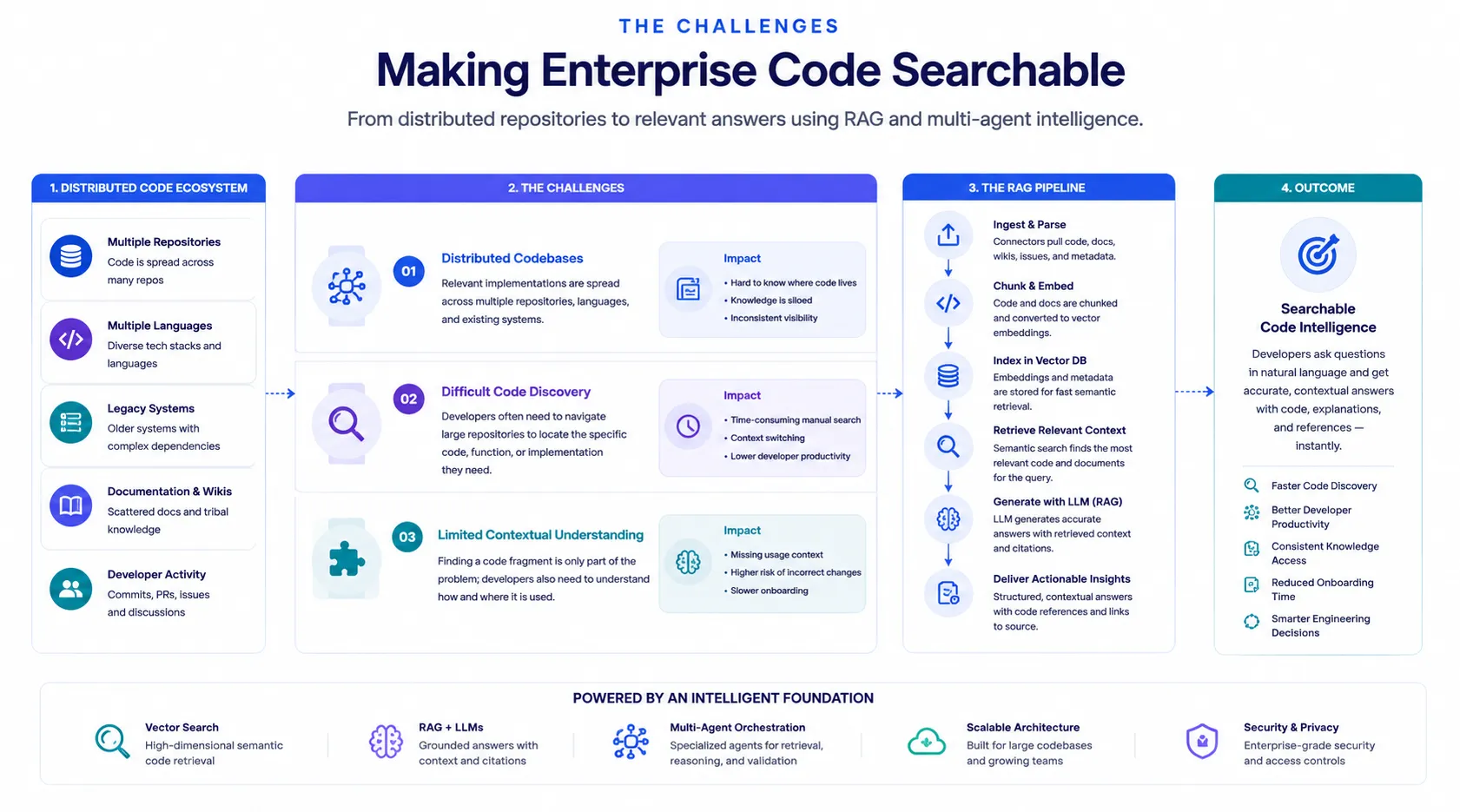
The challenge was not simply accessing source code. It was finding the right implementation and understanding its context across a large and distributed engineering environment. Amgen needed a way to make existing code easier to discover while reducing the time developers spent manually navigating repositories. Three challenges shaped the system.
- Distributed Codebases – Relevant implementations were spread across multiple repositories, languages, and existing systems.
- Difficult Code Discovery – Developers often needed to navigate large repositories to locate the specific code, function, or implementation they needed.
- Limited Contextual Understanding – Finding a code fragment was only part of the problem; developers also needed to understand how and where it was used.
03 A RAG System Built Around the Codebase
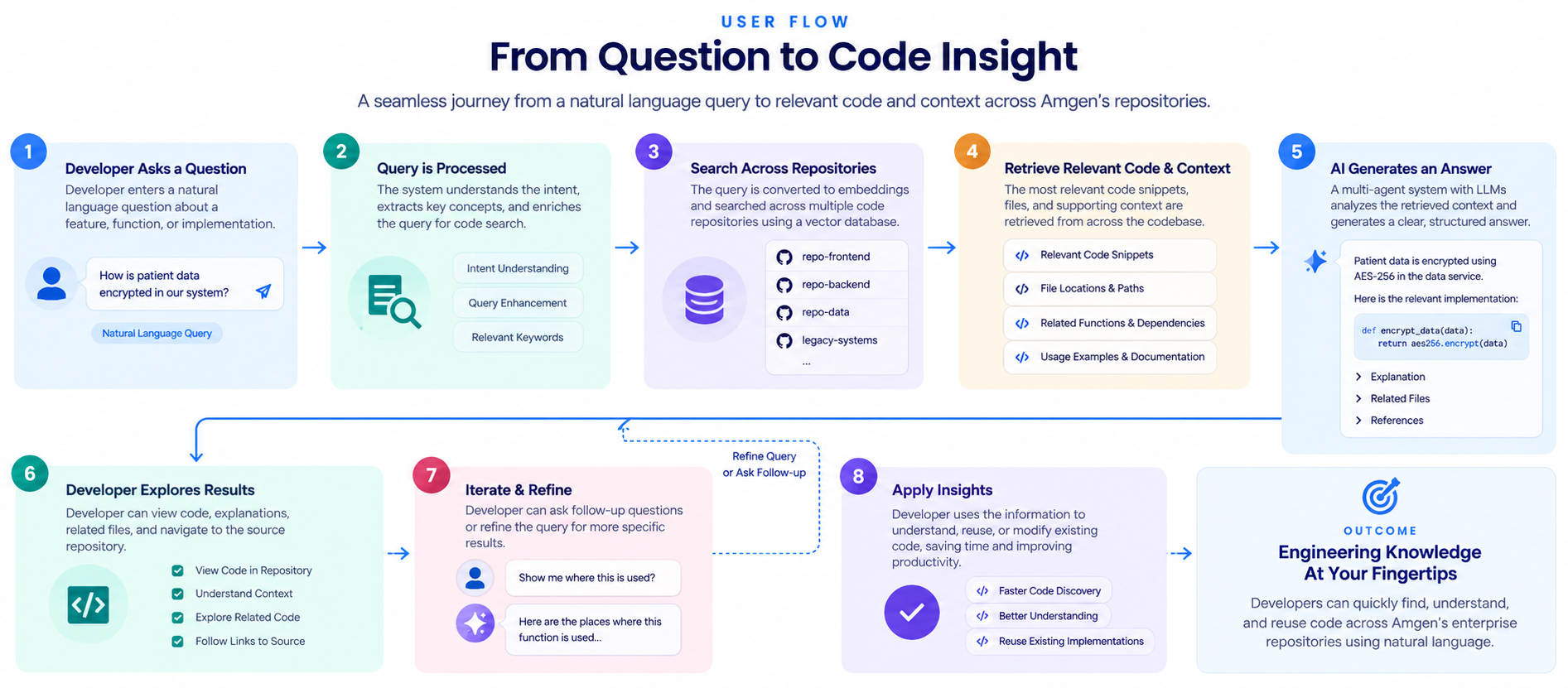
Adople AI designed and deployed a code intelligence pipeline that ingests enterprise repositories, generates semantic embeddings, and indexes code within a scalable vector database. Retrieval-Augmented Generation enables developers to query the codebase using natural language and retrieve the most relevant implementations and supporting context. A multi-agent orchestration layer coordinates retrieval and reasoning, while large language models generate explanations of complex code and its surrounding logic. The result is a searchable intelligence layer that helps developers navigate existing code more efficiently.